


Behind the scenes at Hadassah Hospital: A journey of discovery, innovation and inspiration!
I was delighted to once again represent Hadassah UK, together with our Chief Executive Rob Taub, at the Hadassah International Professional Team Training, joining colleagues from Australia, Europe, Canada and Latin America for an intensive five-day programme in Jerusalem.
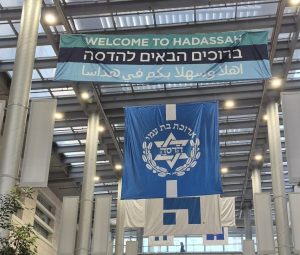
Arriving at Hadassah Ein Kerem
It was a wonderful opportunity to see first-hand the inspiring work taking place across Hadassah Hospital’s two campuses, Ein Kerem and Mount Scopus, and to learn more about the latest developments in medical research, innovation and patient care. While some of our group had been with the organisation for many years and were excited to see the progress achieved, others were visiting for the first time, experiencing the remarkable work of Hadassah with fresh eyes.
Before exploring both hospitals, it was important to understand and appreciate the history of this vast, modern medical institution and the vision of one extraordinary woman, Henrietta Szold.
Henrietta Szold – Founder of Hadassah
In 1909, Henrietta Szold visited Jerusalem, where she was deeply affected by the poverty, poor sanitation and widespread disease, particularly trachoma among children.
Determined to improve healthcare, in 1912 she founded Hadassah, the Women’s Zionist Organization of America, alongside 37 other women. Her vision was to provide healthcare, education and humanitarian support to all communities, regardless of their religion or background. In 1913, Hadassah sent two nurses to Jerusalem, marking the beginning of its medical mission.
Hadassah Hospital Mount Scopus
Hadassah University Hospital opened on Mount Scopus in 1939, becoming the first teaching hospital and medical centre in the region. Following the division of Jerusalem in 1948, access to the hospital was lost for 19 years. After 1967, extensive rebuilding began, and in 1975 the hospital was officially rededicated, continuing its mission of providing medical care to Jerusalem’s diverse communities.
Hadassah Hospital Ein Kerem
Following the loss of access to Mount Scopus, Hadassah continued providing medical care from temporary facilities across Jerusalem until a permanent replacement hospital could be built. In 1961, Hadassah Hospital Ein Kerem opened as a major centre for patient care, research, teaching and innovation. Despite suffering damage in 1967, the campus continued to develop into a leading medical institution.
Hadassah Ein Kerem – Highlights
During our visit, I was most impressed by how Hadassah Ein Kerem brings together advanced technology, medical research and specialist care, whether in times of peace or conflict.
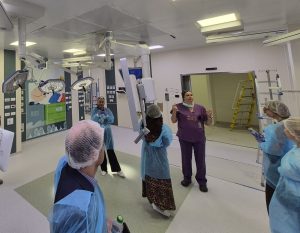
Registered Operating Room Nurse Kristina Hanna showed us Hadassah Ein Kerem’s protected operating suite, four floors below ground.
Its protected underground operating theatres enable lifesaving surgery during emergencies, while the Wohl Institute for Translational Medicine helps turn scientific discoveries into potential treatments. The Trauma Centre, Heart Centre and Brain Catheterisation Lab also demonstrate the hospital’s expertise in managing complex medical conditions.
We were privileged to meet specialists from a wide range of disciplines, each speaking enthusiastically about their work and with genuine compassion for their patients.
Prof Saar Hashavya – International and Humanitarian Collaborations
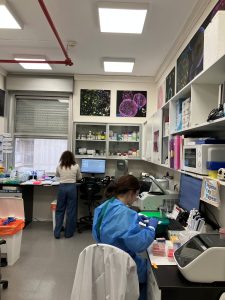
PhD Student Deborah Duran explains about the work of the Hadassah Organoid Centre
Prof Hashavya combines his expertise in paediatric emergency medicine and intensive care with international humanitarian work. He avidly leads collaborations that share Hadassah’s medical knowledge worldwide, strengthen emergency healthcare and support vulnerable communities.
Hadassah Organoid Centre – PhD Student Deborah Duran
Deborah gave us a fascinating introduction to personalised medicine, explaining how miniature, three-dimensional models of human organs are grown from patients’ cells. These organoids enable researchers to study diseases, test treatments and better understand how individual patients may respond to different therapies, opening up exciting possibilities for the development of new and more effective treatments.
Prof Eyal Mishani – Research, Development and Innovation
Prof Mishani, an accomplished scientist, explained how Hadassah’s Research, Development and Innovation Division works alongside Hadasit, its technology transfer company, to transform medical research into practical applications. Their work supports scientific discoveries, commercial partnerships and the development of new medical technologies and treatments.
Prof Aron Popovtzer – Cancer Research and Oncology
Prof Popovtzer leads the Sharett Institute of Oncology, combining advanced cancer treatment with clinical research. His groundbreaking work focuses on precision oncology, innovative radiotherapy and personalised treatments, aiming to improve survival rates, reduce side effects and enhance patients’ quality of life.
Prof Tamar Harel – Genetic and Metabolic Diseases
Award-winning geneticist Prof Harel leads pioneering research into rare genetic and inherited disorders. Using advanced genomic sequencing, her team identifies disease-causing mutations and explores innovative RNA-based therapies, offering new possibilities for patients and families affected by rare conditions.
Prof Shai Rosenberg – Digital Medicine and Artificial Intelligence
Lastly we heard from Prof Rosenberg, who expressed the growing and important role of artificial intelligence (AI) in cancer diagnosis and treatment. His research uses machine learning and genetic data to identify cancer-causing mutations and predict treatment responses, helping to significantly advance personalised cancer care.
Hadassah Mount Scopus
Our second day included a tour of the Mount Scopus campus, visiting the Henrietta Szold Museum, Hadassah Hospice, Gandel Rehabilitation Centre and Paediatric Trauma Centre.
Gandel Rehabilitation Centre
Opened in 2024, this has been a flagship project for Hadassah UK and Hadassah International due to the overwhelming rise in injured patients needing rehabilitation after October 7.
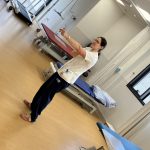
Hadassah Physical Therapist Adeena Jacobs Stampfer.
An in-depth tour of the centre’s physiotherapy department with physical therapist Adeena Jacobs Stampfer gave us a fascinating insight into the patient’s journey from injury to recovery.
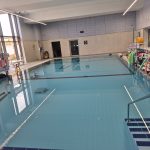
Hydrotherapy pool at the Gandel Rehabilitation Centre
Dr. Elior Moreh, Head of the Department of Physical Medicine and Rehabilitation, further explained the holistic multi-disciplinary approach of doctors, physiotherapists, occupational therapists, speech therapists, nurses, psychologists and social workers working together to help patients regain or improve their physical, cognitive, and emotional abilities needed for daily life and independence.
Dr Fortunato Benarroch – PTSD and Trauma Care
It was particularly moving to listen to Dr Benarroch, Director of the Centre for Paediatric Traumatic Stress, as he spoke with great humility and dedication about his work supporting children and adolescents severely affected by October 7 and the continuing conflict.
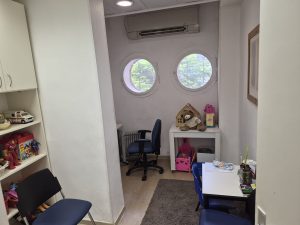
Therapy Room at the Centre for Paediatric Traumatic Stress
He explained how the department has experienced a significant increase in young patients requiring urgent mental-health care; with demand now exceeding capacity, some patients are having to wait for care. Therapy sessions take place in now outdated facilities, in desperate need of refurbishment.
Beyond conflict-related trauma, the centre also supports children facing family breakdown, substance misuse and domestic violence, providing essential care during particularly difficult times. The clinic also trains health care professionals across the country and undertakes revolutionary research in understanding the mechanisms of trauma to develop ways to prevent the onset of PTSD.
Looking Ahead
Our conference concluded with two full days of strategic planning, team discussions and collaboration, exploring our future direction and identifying opportunities to strengthen existing projects. We returned to the UK with renewed enthusiasm for the work ahead and a greater appreciation of the remarkable achievements taking place across both campuses.
I am extremely grateful to all the medical and administrative staff who generously shared their time and expertise, making our visit both memorable and informative. The unique spirit of Hadassah remains with us as we return with fresh ideas and inspiration to continue our important work at Hadassah UK.
Editor Notes: Article by Candice Janet, Hadassah UK Charity Development and Admin. Manager, Nov 26
Photographer credit: Rob Taub and Candice Janet


